
Labyrinth
A Physical Path for our Spiritual Journey
ABOUT
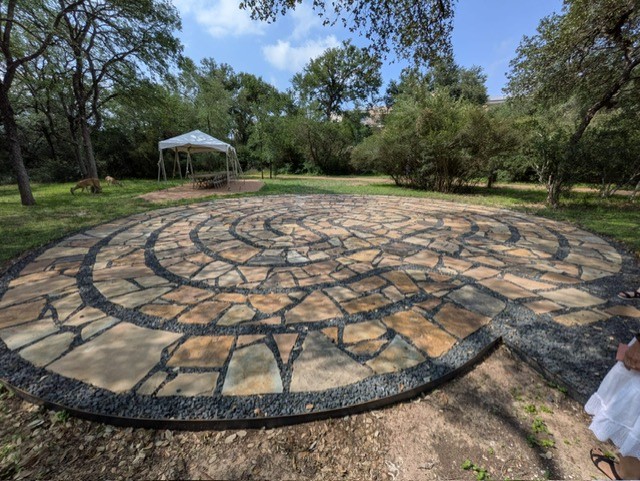
A labyrinth is a circular path with a single route leading from the outside to the center and back out again. Often used for meditation, reflection and spiritual experiences, a labyrinth holds many lessons connected to one’s life. Many ask how a labyrinth is different from a maze? In a maze, one can find themselves at a dead end and lost as mazes are often designed to cause confusion. The purpose of walking through a labyrinth is not to figure out where one is going, but rather to meditate and attune oneself to the journey, with all the twists and turns on the path.
In Jewish tradition, a labyrinth often has seven circuits. The number seven has multiple meaningful connections in Judaism including the seven days of creation, the seven weeks of the counting of the omer, the sabbatical year and more. These seven circuits are connected to the city of Jericho, which is the last city that stood between the Israelites as they entered the promised land in the book of Joshua.
Our Labyrinth was generously donated by Dr. Matthew & Lori Steinberg. Members of the Dell Jewish Community Center can access the labyrinth from the Garber Family Nature Trail. Vistors may contact the Dell JCC to schedule a tour.
Listen to The Labyrinth Walking Meditation
Labyrinth Walking Meditation
To read the transcript of the audio file, click here.
The Jewish Elements of Our Labyrinth

In Joshua, chapter 6, verses 2-6 we read,
God said to Joshua, see, I will deliver Jericho into your hands-it’s kings and warriors. Let all your troops march around the city and complete one circuit of the city. Do this six days, with seven priests carrying seven ram’s horns preceding the Ark. On the seventh day, march around the city seven times, with the priests blowing the horns. And when a long blast is sounded on the horn-as soon as you hear that sound of the horn-all the troops shall give a mighty shout. Thereupon the city wall will collapse, and the troops shall advance, every man straight ahead.
In medieval Jewish manuscripts Jewish labyrinths are illustrated with seven circuits, inspired by this text from the book of Joshua. Our ancestors and Jewish tradition continued to use this story as a metaphor, the circuits of a labyrinth representing the challenges, the twists and turns we face as we move forward in life. This labyrinth follows in this tradition, while layering on the kabbalistic sefirot.
When you walk the labyrinth, you will find Hebrew and English words that are called sefirot, engraved into eleven stones. The sefirot are central to the kabbalistic understanding of divinity, the world and each one of us. The sefirot themselves are organized in the shape commonly referred to as the Tree of Life and they are placed on the labyrinth reflecting that shape. Different Kabbalistic traditions have different understandings of the sefirot.
Each sefirah has a name and represents one aspect of God. Every sefirah is identified with a part of the body, and they interact, offer balance and are in relationship with each other in their shape and personalities, representing the internal life of God. The sefirot interact with humans as well and they are associated with different biblical characters.
One way of understanding the sefirot are as energies of the divine, that interact with one another. In studying and practicing the sefirot we balance and integrate the sefirot in our lives, through our interactions with one another and with God. This practice recognizes that human beings are a microcosm of the divine and the entire universe and that we all share these attributes within us.
In the mussar tradition, the sefirot are also referred to as middot, which is often translated as character traits or virtues, or as measures. We study and practice these middot in order to embody them in our lives and especially in our relationships with everyone we meet.
Kabbalist Moses Cordovero writes, “The essence of divinity is found in every single thing.”
Finally, the sefirot can be understood as channels of divine energy moving from the top of the tree to the bottom, or as a ladder to climb for those aspiring to the divine realm of being. The kabbalistic tradition teaches that divine energy flows into the world, depending on how wide or narrow the channels of sefirot are. Our role as human beings, in the kabbalistic tradition is to widen the channels so divine energy can flow into the world.
Outside of the sefirot, there is an aspect of God that cannot be known by humans, called the ain sof, translated as endless, infinite. Maimonides teaches that this aspect of God cannot be known, so in contrast, the sefirot enable human beings to interact with God.
When you listen to the meditation, you will learn more about each sefirah on your journey.
Sefirot
In her prayer book, “Beloved of the Soul,” Sara Evian provides us with insights on the sefirot, the words you will encounter which are inscribed in the stones as you walk the Labyrinth. Sefirot can be understood, from the Kabbalistic tradition, as divine emanations of God or attributes that we share with God.
Keter is the head of the sefirot. Keter connects us to a higher purpose, that which is beyond our understanding but that purpose that motivates us in life. Keter gives our soul it’s inspiration to express itself.
Chochma is an inspiration or spark that inspires wisdom. Chochma is considered to be the spark that ignites the potential of our creativity.
Bina is understanding. Binah receives the spark of wisdom from chochma, and gives it life. Bina grounds and settles wisdom into the mind. Bina helps us focus our thoughts, leading to greater understanding.
Da’at is translated as knowledge and means, “to know.” Da’at is connected to the idea of attachment and absorption, Da’at allows us to feel that which is now understood.
Chesed is loving kindness, a flow of energy that connects us to each other. With chesed, we give and express kindness unconditionally, without judgement.
Gevurah is strength and acts as a balance to loving kindness. Gevurah can also be translated as discipline, restraint or concealment. For some, gevurah inspires courage in the face of injustice.
Tiferet is the beauty that can be found when opposites are joined and harmony between diverse elements is achieved. Tiferet draws out the inner unity of a multifaceted world, while allowing each unique dimension to be. Tiferet is found when we offer deep compassion and empathy to those in need.
Netzach is victory or endurance which propels us forward, helping us move in the direction that we need to go. Netzach gives us the courage and energy needed to take risks and to have faith in our decisions, one step at a time.
Hod, working in partnership with netzach, offers us splendor and meaningful acceptance of what is rather than what could be. Hod provides us with gratitude.
Yesod is our Foundation. A tree without firm, strong roots, cannot stand tall. Yesod is connected to truth which allows us to live our lives with dignity and it provides us with the capacity for inner peace and calm. Yesod is placed directly above malchut, channeling all of the sefirot together, their energies combined into the center of our tree.
Malchut is translated as a kingdom, majesty or sovereignty. In our context, malchut is an empty vessel, just as royalty exist to serve their communities, malchut exists to receive all the other sefirot. When we enter a space ready to receive, rather than ready to offer and give, we make space for others, in this case the other sefirot, to become themselves.
Our Labyrinth was inspired by Matthew and Lori Steinberg, designed by Heather Ruggero in collaboration with Rabbi Amy B. Cohen and installed by Paul’s Lawn and Landscape LLC.
Labyrinths Around the World
To locate labyrinths around the world, click here.
CONTACT US
7300 HART LANE
AUSTIN, TEXAS 78731
(512) 735-8000

Follow Us:


HEALTH & WELLNESS
Fitness
Swimming
Tennis & Pickleball
Sports
EDUCATION
Jewish Culture & Education
Early Childhood Program Preschool
After School & Childcare
Camps
ARTS & CULTURE
Literary Arts
Visual Arts
Theatre & Film
Dance
COUNSELING & SUPPORT
Jewish Family Service
Counseling & Groups
Case Management
References & Resources
Disability & Inclusion

Copyright Shalom Austin 2025. Privacy Policy.